Using Slide Rules · Volume 3
Using Slide Rules — Volume 3 — Powers and Roots
Squaring and cubing with A, B, and K; arbitrary powers with the log-log scales
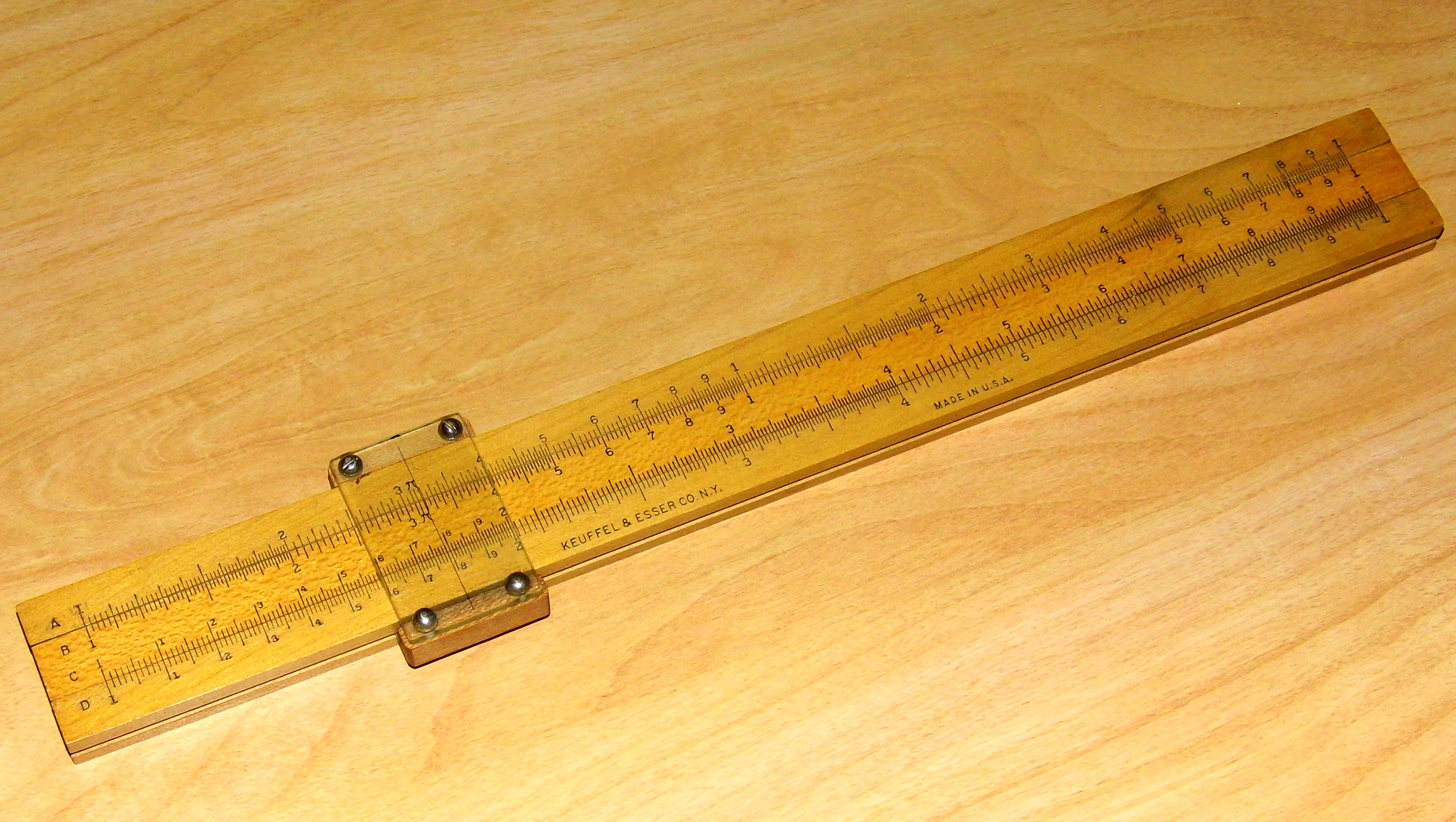
Figure 1 — A working slide rule with the squares scales in place: A runs along the top of the body, B along the top of the slide, and C/D below. Squaring a number is a single move from D to A. Photo: “Vintage Keuffel & Esser Company Beginner’s Slide Rule, No. 4058C, All Wood Framed Cursor, Made In USA, Circa 1930s (46171984654)” by Joe Haupt from USA is licensed under CC BY-SA 2.0. To view a copy of this license, visit https://creativecommons.org/licenses/by-sa/2.0/.
3.1 About This Volume
The first two volumes of this unit covered the heart of slide-rule work: multiplication and division on the C and D scales, and the family of folded and inverted scales that make chaining fast. This volume turns to the next operations every engineer needed — raising to powers and extracting roots. Three tools do the job. The A and B scales square and take square roots in a single motion. The K scale cubes and takes cube roots. And the log-log (LL) scales generalize the whole idea, letting one raise any number to any real power — 2^3.5, 1.5^2.7, even eˣ and natural logarithms — without a table in sight.
The reading and significant-figure conventions established in Vol 1 apply throughout: the rule gives the digits of an answer, and the operator supplies the decimal point by estimation. That division of labor matters more here than anywhere else, because the A, B, and K scales fold several decades into one physical length and will happily hand back the right digits for the wrong power of ten if one is not paying attention.
3.1.1 Depth-Index: The Five-Volume How-To Unit
Table 1 — Depth-Index: The Five-Volume How-To Unit
| Vol | Title | Primary Content |
|---|---|---|
| 1 | Anatomy and the Logarithmic Principle | Parts, why sliding multiplies, reading, sig figs, decimals |
| 2 | Multiplication and Division | C/D, chaining, CI, folded CF/DF, off-scale |
| 3 | Powers and Roots (this volume) | A/B (squares), K (cubes), the log-log (LL) scales, eˣ |
| 4 | Trigonometry and Logarithms | S, ST, T scales, the L mantissa scale, gauge marks |
| 5 | Reading Circular and Cylindrical Rules | Wrap-around and spiral scales; Fowler, Otis King, Fuller |
Note — Cross-references appear as “see Vol N.” Each volume is self-contained; this one assumes only the basic reading skills of Vol 1.
3.2 Squares and Square Roots — the A and B Scales
The A and B scales are the oldest power scales on the rule, and the cleverest in their simplicity. A sits on the body (stator), usually along the top edge; B is its identical twin on the slide. Each runs through two decades — 1 to 10, then 10 to 100 — laid out in the same length that the D scale uses for a single decade of 1 to 10. Because A is compressed to exactly half the scale-per-decade of D, a number’s position on D lines up with the position of its square on A. That is the entire trick: A is D with its logarithms halved, and halving the logarithm is squaring the number.
3.2.1 Squaring
To square a number, set the cursor hairline over the number on D and read the answer directly above on A. No part of the slide moves.
- 3² = 9. Hairline over 3 on D; read 9 on A. (3 falls in the left, 1–10, half of A.)
- 1.5² = 2.25. Hairline over 1.5 on D; read 2.25 on A.
- 7² = 49. Hairline over 7 on D; read 49 on A — this time in the right, 10–100, half of A.
The decimal point is found by estimation, exactly as in Vol 1. For 47², estimate 47 ≈ 50, so the answer is near 2 500; the rule’s digits read “2209,” giving 2 209.
3.2.2 Square roots — and the half-scale subtlety
Taking a square root reverses the move: find the number on A, drop the hairline to D, and read the root. The complication — the single most common stumbling block on the whole instrument — is that A has two halves that look alike, the 1–10 stretch on the left and the 10–100 stretch on the right. The same digits “5.0” appear in both halves, but they mean 5 on the left and 50 on the right, and they have different roots. Choosing the wrong half gives an answer off by a factor of √10 ≈ 3.16.
The reliable rule is to pair off the digits in groups of two, starting from the decimal point, and look at the leftmost group:
- If the leftmost group has one digit (an odd number of digits before the decimal), use the left half of A.
- If the leftmost group has two digits (an even number of digits), use the right half of A.
Two worked cases make the difference concrete:
- √50 ≈ 7.07. Group the digits: “50” — one group of two digits, so use the right half of A. Set the hairline over 50 in the right half; read 7.07 on D. (Check: 7.07² = 49.98.)
- √500 ≈ 22.4. Group the digits: “5 00” — the leftmost group is the single digit “5,” so use the left half of A. Set the hairline over 5 in the left half; read the digits 2236 on D. Estimation places the point — √500 is between √400 = 20 and √900 = 30 — giving 22.4.
So 50 and 500, which differ by only one factor of ten, are read from opposite halves of A. For numbers less than 1, the pairing continues across the decimal point in the same way: √0.5 pairs as “0.50” (leftmost significant group “50,” two digits → right half, root ≈ 0.707), while √0.05 pairs as “0.05” → left half, root ≈ 0.224. Pairing from the decimal point, in both directions, never fails.
The B scale on the slide is A’s twin and is used the same way; it comes into its own when a square or square root must be combined with a multiplication or division in one setting, since B participates in the sliding action while A stays fixed.
3.3 Cubes and Cube Roots — the K Scale
The K scale extends the idea by one more decade. Where A folds two decades into the D scale’s one, K folds three — 1 to 10, 10 to 100, and 100 to 1000 — into the same length. K is therefore D with its logarithms divided by three, and dividing the logarithm by three takes the cube root; reading the other way, from D up to K, cubes.
3.3.1 Cubing
Set the hairline over the number on D and read its cube on K.
- 2³ = 8. Hairline over 2 on D; read 8 on K (left third).
- 4³ = 64. Hairline over 4 on D; read 64 on K (middle third).
- 5³ = 125. Hairline over 5 on D; read 125 on K (right third).
3.3.2 Cube roots — choosing the correct third
For cube roots the reverse holds: find the number on K, read the root on D. Now K has three identical-looking decades, so the digit-grouping rule uses groups of three, counted from the decimal point. The leftmost group selects the third of K:
- Leftmost group of one digit → left third (1–10).
- Leftmost group of two digits → middle third (10–100).
- Leftmost group of three digits → right third (100–1000).
Worked examples:
- ∛1000 = 10. Group as “1 000” — leftmost group “1,” one digit, left third. The point 1000 sits at the far right end of K’s left-third decade, reading 10 on D. (Equivalently, 1000 is exactly the start of the right third; either reading gives 10.)
- ∛50 ≈ 3.68. Group as “50” — one group of two digits, middle third. Set the hairline over 50 in the middle third; read 3.68 on D. (Check: 3.68³ = 49.8.)
- ∛8000 = 20. Group as “8 000” — leftmost group “8,” one digit, left third; digits read “2,” and estimation (∛8000 = ∛8 × ∛1000 = 2 × 10) places the point at 20.
As with square roots, the grouping continues across the decimal point for numbers below 1: ∛0.05 groups as “0.050” → the first nonzero group is “050,” a three-digit group, so the right third is used. The principle — count off the digits in threes from the decimal point — is the cube-root analogue of the square-root pairing, and it is worth committing to memory because the K scale gives no other clue about which third one is reading.
3.4 The Log-Log Scales — Arbitrary Powers and Roots
A and B handle squares; K handles cubes. But engineering is full of powers that are neither — compound interest at 1.03^12, a fan law at (speed ratio)^2.5, decay as e^−t. For these the high-end “log-log duplex” rules carry a family of log-log (LL) scales, the most powerful feature on any slide rule.
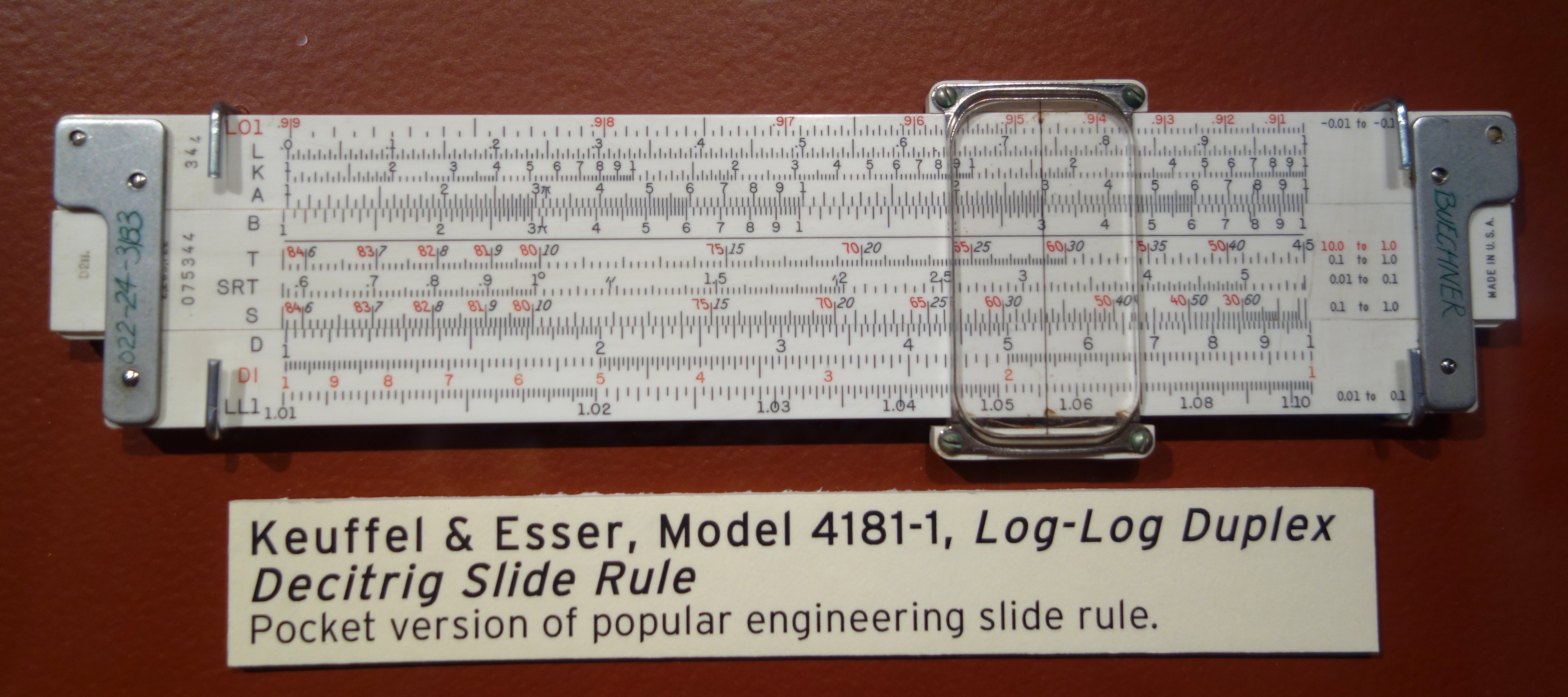
Figure 2 — A log-log duplex rule. The LL scales (here LL1/LL2/LL3 and their reciprocals) let the operator raise any number to any real power. Photo: File:Keuffel & Esser Model 4181-1, Log-Log Duplex Decitrig Slide Rule - MIT Slide Rule Collection - DSC03634.JPG by Daderot. License: CC0 (http://creativecommons.org/publicdomain/zero/1.0/deed.en). Via Wikimedia Commons (https://commons.wikimedia.org/wiki/File%3AKeuffel%20%26%20Esser%20Model%204181-1%2C%20Log-Log%20Duplex%20Decitrig%20Slide%20Rule%20-%20MIT%20Slide%20Rule%20Collection%20-%20DSC03634.JPG).

3.4.1 What a log-log scale is
The ordinary C and D scales are single-logarithmic: position is proportional to log of the number, so adding lengths multiplies. A log-log scale goes one level further — position is proportional to the logarithm of the logarithm. Concretely, an LL scale is built so that the distance along it represents the natural logarithm (ln) of the value printed there. Setting an LL scale against the ordinary D (or C) scale therefore multiplies a natural logarithm by an ordinary number, and multiplying ln x by y is exactly the operation inside xʸ:
xʸ = e^(y · ln x)
That single identity is why one pair of scales — an LL scale for the value, D or C for the exponent — computes every power and root there is.
3.4.2 The LL family and its ranges
Because ln grows slowly, no single LL scale can cover everything, so the scales come in a graded set. A typical full duplex rule carries three “greater-than-one” scales and three reciprocal “less-than-one” scales (makers’ names vary — K&E uses LL1/LL2/LL3, others LL0–LL3):
Table 2 — Because ln grows slowly, no single LL scale can cover everything, so the scales come in a graded set. A typical full duplex rule carries three "greater-than-one" scales and three reciprocal "less-than-one" scales (makers' names vary — K&E uses LL1/LL2/LL3, others LL0–LL3)
| Scale | Exponent decade it represents | Value range it covers |
|---|---|---|
| LL1 | e^0.01 … e^0.1 | ≈ 1.010 to 1.105 |
| LL2 | e^0.1 … e^1 | ≈ 1.105 to 2.718 |
| LL3 | e^1 … e^10 | ≈ 2.718 to 22 026 |
| LL01 / LL00 | e^−0.01 … e^−0.1 | ≈ 0.990 to 0.905 |
| LL02 / LL0 | e^−0.1 … e^−1 | ≈ 0.905 to 0.368 |
| LL03 | e^−1 … e^−10 | ≈ 0.368 to 0.0000454 |
Each LL scale spans one decade of the exponent (a factor of ten in ln-space), and the three together run continuously from about 1.01 up past 22 000. The reciprocal LL scales (for bases between 0 and 1, such as e^−x) handle decay problems and fractional bases. Unlike A, B, and K, the LL scales do not repeat — every value appears in exactly one place, so there is no half-or-third ambiguity and, helpfully, the decimal point is built in: the LL scales read true values, not just digit strings.
3.4.3 Computing xʸ
The procedure aligns the value on an LL scale with the exponent on C, then reads the result back on an LL scale:
- Set the cursor hairline over the base x on the LL scale that contains it.
- Slide the C scale so its index (the 1) sits under the hairline.
- Move the hairline to the exponent y on C.
- Read xʸ under the hairline on whichever LL scale the cursor now crosses.
The answer often lands on a different LL scale from the base, and that is expected: multiplying ln x by y can push the result into a higher (or lower) exponent decade. The cursor carries the eye to the correct scale automatically.
- 2^3.5 ≈ 11.3. Set the hairline on 2 (on LL2); bring the C index under it; move to 3.5 on C; read 11.31 on LL3. (Check: 2^3.5 = 11.314.) Because the result exceeds e ≈ 2.718, it appears on LL3 rather than LL2 — a visible reminder that the answer crossed into the next decade.
- 1.5^2.7 ≈ 3.0. Set the hairline on 1.5 (on LL2); C index under it; move to 2.7 on C; read just past 3 — about 2.99 — at the LL2/LL3 boundary. (Check: 1.5^2.7 = 2.989.)
Roots are simply powers with fractional exponents, so they use the same setup. A fifth root is the 0.2 power; the 2.5 power of a number is found exactly as above with y = 2.5. When the exponent is the reciprocal of an integer (an n-th root), many operators set y with the CI scale (see Vol 2) to avoid arithmetic, but the LL-against-C method works directly for any y, integer or not.
3.4.4 eˣ and natural logarithms, read directly
Because each LL scale is laid out so that distance equals ln of the value, the LL scales also read powers of e and natural logs with no slide motion at all — the exponent lives on D, the value on the LL scale:
- eˣ: set the hairline over x on D and read eˣ on the LL scale whose exponent decade contains x. For e² ≈ 7.39, x = 2 lies in the 1–10 decade, so read on LL3: the hairline crosses 7.39. For e^0.5 ≈ 1.65, x = 0.5 lies in the 0.1–1 decade, so read on LL2: about 1.649.
- ln x: reverse the move — set the hairline over x on an LL scale and read its natural log on D. Over 2 on LL2, D reads 0.693 (ln 2 = 0.6931); over 7.39 on LL3, D reads 2.
Common (base-10) logarithms have their own dedicated L scale, covered in Vol 4; the LL scales give natural logs, which is exactly what eˣ problems call for.
3.5 When to Use Which
A practical operator keeps all three tools in hand and reaches for the cheapest one:
- For a plain square or square root, the A/B scales are fastest — one motion, no slide. Mind the half-scale rule.
- For a plain cube or cube root, the K scale does it in one motion. Mind the thirds.
- For anything else — non-integer powers, fractional or negative exponents, eˣ, natural logs, compound-growth and decay factors — the LL scales are the general instrument, and they carry the decimal point for free.
There is overlap, and it is useful: a 2.5 power could in principle be assembled from squares and square roots, but the LL scales do it in one reading. Conversely, when only a quick square is needed, dropping to A is faster and more accurate than threading the LL setup. As always (Vol 1), the rule supplies three significant figures and the operator supplies judgment — most of all in placing the decimal point and, on A, B, and K, in choosing the correct repeated section of the scale.
Sources
- International Slide Rule Museum — scale descriptions and operating instructions (https://sliderulemuseum.com).
- The Oughtred Society — Slide Rule Reference Manual and All About Slide Rules (https://www.oughtred.org).
- Keuffel & Esser, Manual for the K&E Log Log Duplex Decitrig Slide Rule (Models 4080 / 4081 / 4181) — A, B, K, and LL scale procedures.
- Pickett & Eckel, How to Use Trig, Log-Log, Slide Rules — LL-scale powers, roots, and exponentials.
- Cajori, F. (1909). A History of the Logarithmic Slide Rule and Allied Instruments.
All worked examples above were verified numerically. The A/B half-scale rule and the K-scale thirds rule are stated in the digit-grouping form used by the classic K&E and Pickett manuals; the LL-scale ranges follow the standard three-decade LL1/LL2/LL3 set and vary slightly in naming between makers, as noted.
Comments (0)