History · Volume 5
The Story of the Slide Rule — Volume 5 — Decline and Legacy
From the peak of the engineer's age to the chip that ended it — and what the slide rule left behind
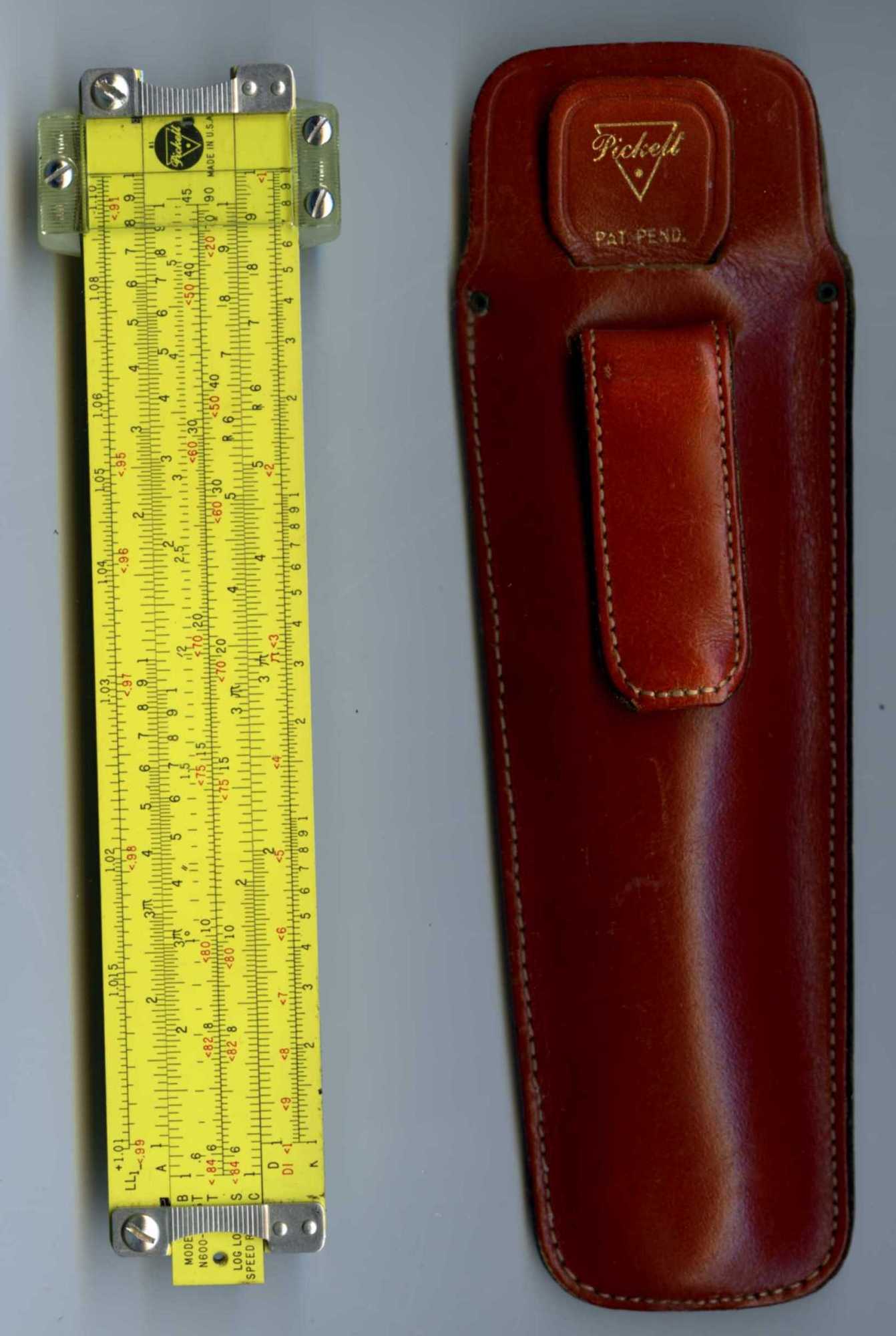
Figure 1 — The Pickett N600-ES “Log Log Duplex” — a six-inch aluminium rule of the type carried aboard the Apollo spacecraft. Few objects better capture the slide rule at its zenith: light, rugged, and trusted to fly to the Moon. Image: “Pickett N600-ES Log Log Duplex Slide Rule” by Pickett & Eckel, Incorporated is marked with CC0 1.0. To view the terms, visit https://creativecommons.org/publicdomain/zero/1.0/.
5.1 About This Volume
This is the final volume of the five-part history. The previous four traced the slide rule from a number trick of 1614 to a mature, precise, beautifully made instrument produced by great firms on three continents. This volume tells how that instrument reached the height of its prestige in the mid-twentieth century — when it was the universal badge of the engineer and even flew to the Moon — and then vanished from working life faster than almost any tool in history, killed within a few years by the pocket calculator. It closes by asking what survived: the habits of mind the slide rule taught, the collectors and societies that keep it alive, and its second life as a teaching object. The mathematics stays at the level of ideas; the mechanics of reading a rule belong to the companion unit, How to Read & Operate a Slide Rule.
5.1.1 Depth-Index: The Five-Volume History
Table 1 — Depth-Index: The Five-Volume History
| Vol | Title | Primary Content |
|---|---|---|
| 1 | Logarithms and the First Scales | Napier’s logarithms, Gunter’s line, Oughtred’s rectilinear and circular rules, the Oughtred–Delamain dispute |
| 2 | Specialized Rules and the Mannheim Standard | Coggeshall’s carpenter’s rule, the Soho engine rule, Everard’s gauging rule, Amédée Mannheim’s 1851 standardization and the cursor, boxwood to celluloid |
| 3 | The Golden Age and the Makers | The duplex rule, log-log scales, and the great firms — Keuffel & Esser, Faber-Castell, Nestler, Aristo, Pickett, Hemmi/Post, Thornton |
| 4 | Round and Cylindrical: The Pursuit of Precision | Why a curved scale buys accuracy — Fowler, Gilson, Thacher, Fuller, Otis King |
| 5 | Decline and Legacy (this volume) | The peak, Apollo’s Pickett, the HP-35, the collapse of the market, and the afterlife — the Oughtred Society and the collectors |
Note — Cross-references appear as “see Vol N §M.” Each volume is self-contained; this one assumes no prior reading.
5.2 The Peak: An Engineer’s Badge
By the 1950s and early 1960s the slide rule had become something more than a tool — it was a symbol. To carry one was to declare a profession. The leather (or, later, plastic) belt holster, worn at the hip, marked its owner as an engineer or a serious student of science as plainly as a stethoscope marks a doctor. American students called it the “slip stick,” and a good rule was a standard high-school and university graduation gift, given the way a watch or a pen might be — an emblem of arrival into the adult world of quantitative work (Oughtred Society; International Slide Rule Museum).
The numbers behind that prestige were enormous. For roughly a century the slide rule was the dominant calculating instrument of the technical professions, and the great makers — Keuffel & Esser, Faber-Castell, Nestler, Aristo, Pickett, Hemmi/Post — turned them out by the millions (see Vol 3). K&E alone is reckoned to have produced on the order of millions of rules over its long history, and at mid-century the firm could not make them fast enough for a booming postwar engineering economy.
What gives the peak its retrospective drama is the work the slide rule actually did. The aircraft of the propeller and early jet age, the great suspension bridges, the hydroelectric dams, the radio and television networks, the first commercial computers, and finally the rockets and spacecraft of the early space age — all of them were designed by men and women working sums on sliding logarithmic scales. The instrument that traded a little precision for great speed (Vol 1 §“Why It Mattered”) had become the quiet engine of an entire technological civilization. It is no exaggeration to say that the hardware of the mid-twentieth century was, to three significant figures, computed on the slide rule.
5.3 Apollo: A Slide Rule on the Moon
No single artifact captures the peak better than the rule that went to the Moon. NASA astronauts carried the Pickett N600-ES — a six-inch, aluminium Log Log Duplex pocket rule — as part of their personal equipment aboard the Apollo spacecraft (Figure 1). It was a scaled-down version of Pickett’s full-size N-series engineering rules, chosen for the obvious reasons that govern spaceflight: it was small, it was extraordinarily light, and it could not fail. Pickett’s all-aluminium construction (a hallmark of the firm, see Vol 3) meant there was nothing to warp, swell, jam, or run out of power; an aluminium slide rule works in a vacuum, in free fall, and on no electricity at all (NASA; Smithsonian National Air and Space Museum; Oughtred Society).
Aboard the missions the rule was a backup and a check — a way to verify a quick calculation, scale a figure, or work a problem by hand if it came to that, independent of the spacecraft’s computers and the room full of mainframes on the ground in Houston. Its practical role was modest; its symbolic weight is hard to overstate. Here was a four-hundred-year-old idea — Napier’s logarithms made into sliding lengths by Oughtred — riding to another world alongside the most advanced guidance computer humanity had yet built. The Apollo program is remembered, rightly, as a triumph of new digital technology; that the astronauts also packed a logarithmic slide rule is a reminder of how recently the old analog instrument was still the trusted fallback of the most demanding engineering on Earth, or off it.
It would also prove to be very nearly the slide rule’s last public moment of glory. Within a few years of the first Moon landings, the instrument that flew to the Moon would be effectively extinct in working life.
5.4 The Cliff: The HP-35 and the End of an Era
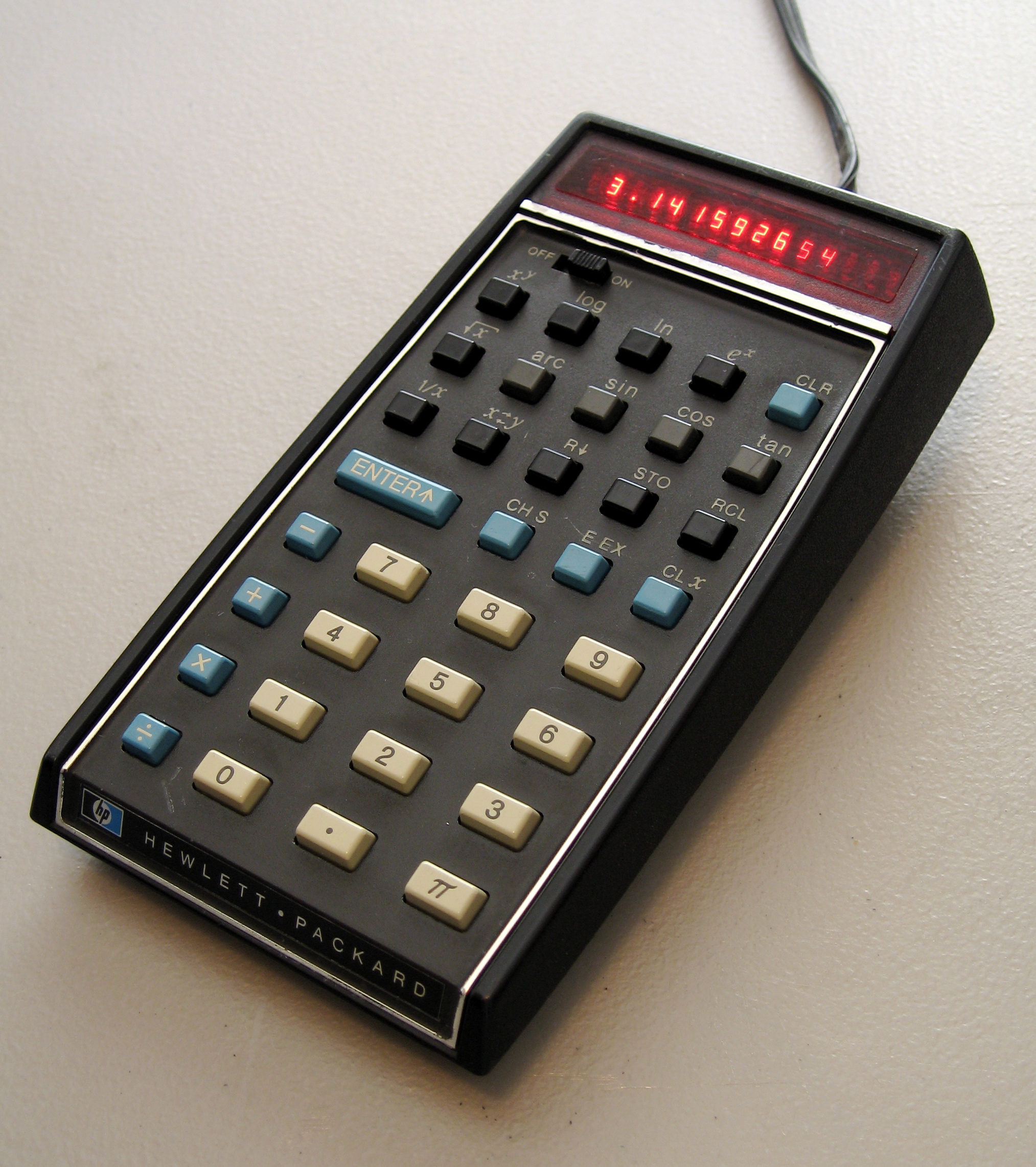
Figure 2 — The Hewlett-Packard HP-35 (1972), the world’s first handheld scientific calculator. At roughly $395 it cost as much as a good used car’s down payment, yet it did instantly and to ten digits what the slide rule did slowly and to three — and it broke the slide-rule market within a few years. Image: File:HP 35 Calculator.jpg by Seth Morabito. License: CC BY 2.0 (https://creativecommons.org/licenses/by/2.0). Via Wikimedia Commons (https://commons.wikimedia.org/wiki/File%3AHP%2035%20Calculator.jpg).

The end did not come gradually. It came as a cliff, and the cliff has a date: 1972, the year Hewlett-Packard introduced the HP-35.
The HP-35 was the world’s first handheld scientific calculator — a pocket-sized electronic device that computed not merely the four arithmetic operations of the existing adding-machine calculators, but the full repertoire that mattered to engineers: logarithms, exponentials, and the trigonometric functions. In other words, it did electronically and instantly precisely the work the slide rule existed to do mechanically and approximately. The story is that HP’s co-founder Bill Hewlett drove the project, insisting the machine be small enough to fit in a shirt pocket; the “35” is generally taken to refer to its thirty-five keys (HP / HP Memory Project; Computer History Museum).
It launched at about $395 — a serious sum in 1972, comparable to a substantial fraction of a month’s professional salary. But the comparison that mattered was not price against pocket money; it was capability against the slide rule. For the price of a good slide rule plus a modest premium, an engineer could now have a device that gave ten significant figures instead of three, never misread a cursor, never lost a decimal point, and required no skill at “placing the decimal” by mental estimation at all. The HP-35 was an immediate sensation and sold far beyond HP’s projections.
What followed was one of the fastest market collapses in the history of manufactured goods. HP’s success drew in competitors — most consequentially Texas Instruments, whose SR-50 (1974) and later low-cost models drove scientific-calculator prices down with brutal speed. Within about three to four years the price of a scientific calculator fell from several hundred dollars to a few tens of dollars, putting one within reach of every engineering student. The slide rule’s single great advantage — that it was cheap, simple, and needed no battery — was overwhelmed by a device that was now nearly as cheap, far more capable, and required no logarithmic skill to use.
The makers read the writing on the wall almost at once. Slide-rule sales fell off a cliff after 1972, and the great firms exited the business within a few years. Keuffel & Esser, the dominant American maker, is reported to have ended slide-rule production around 1975–1976; the company donated its slide-rule engraving equipment to the Smithsonian, a quietly elegiac gesture that effectively closed the American chapter of the trade (Oughtred Society; International Slide Rule Museum; Smithsonian). The European houses converted, contracted, or closed their rule lines over the same brief span. An instrument that had reigned for three centuries, and that had been the indispensable companion of the technical professions only a decade earlier, was commercially dead before the end of the 1970s. A student who entered engineering school with a slide rule on his belt could graduate having replaced it with a calculator in his pocket.
5.5 Afterlife: What the Slide Rule Left Behind
The slide rule vanished as a working tool, but it did not vanish without leaving something behind — and what it left is more interesting than mere nostalgia.
A way of thinking about numbers. Because a slide rule shows only the significant figures of an answer and never the decimal point, its user had to carry the order of magnitude in his head, estimating before computing whether the result should be near 3, or 30, or 3000. This forced a constant, low-level sanity check on every calculation: an answer that came out a hundred times too large announced itself immediately, because the operator had already formed an expectation. The slide rule thus trained a feel for numbers — an intuition for orders of magnitude, for significant figures, and for the reasonableness of a result — that the calculator, by handing over ten flawless digits with no demand for thought, quietly let atrophy. Engineers who learned on the slide rule often remark that it taught them to estimate first and compute second, a discipline many consider the instrument’s most valuable and most lamented legacy.
Collecting. As the working rules emptied out of desk drawers and engineering offices in the late 1970s and 1980s, a second life began. What had been a disposable commodity became a collectible: the finely made duplex rules of K&E and Faber-Castell, the exotic cylindrical and circular instruments of Thacher and Fuller (see Vol 4), the all-aluminium Picketts that flew to the Moon — all acquired value as historical objects and as examples of a vanished craft of precision engraving. A worldwide community of collectors grew up around them, trading rules, documenting models and serial numbers, and preserving the catalogues and manuals that might otherwise have been lost.
The Oughtred Society. That community found its institutional home in 1991, when a group of collectors founded the Oughtred Society in California — named, fittingly, for the man who first let two logarithmic scales slide past one another (Vol 1). The Society has since become the principal scholarly body for slide-rule history, publishing the Journal of the Oughtred Society, holding meetings and swap meets, and serving as a clearing-house for the research that much of this history relies upon (Oughtred Society, https://www.oughtred.org/).
The International Slide Rule Museum. Alongside it, the International Slide Rule Museum — a large online archive — has assembled an extensive digital collection of rules, manuals, catalogues, and reference material, making the documentary record of the instrument freely available in a way the paper-bound collecting world never could (International Slide Rule Museum, https://www.sliderulemuseum.com/). Together the Society and the Museum ensure that the slide rule, dead as a tool of trade, remains thoroughly alive as a subject of study.
The classroom. Finally, the slide rule has found a modest but genuine afterlife in education. Precisely because it makes the logarithm visible — because multiplying really is adding two lengths, there on the rule in front of you — it is a superb teaching object for showing students what a logarithm is, as opposed to which button to press. A number of teachers reach for a slide rule when introducing logarithms and exponents for exactly this reason: the instrument that once computed answers now, more usefully, explains them.
5.6 A Number Trick, the Moon, and a Chip
It is worth standing back, at the close of this history, and taking in the whole arc.
It began (Vol 1) with a Scottish laird’s number trick: John Napier’s discovery in 1614 that multiplication could be turned into addition by way of logarithms. A clergyman, Edmund Gunter, laid those logarithms out as lengths along a ruler; another clergyman, William Oughtred, set two such rulers sliding past one another, and the slide rule was born. For three centuries it grew in refinement and reach — specialized rules and a standard pattern (Vol 2), the great duplex log-log rules of the golden-age makers (Vol 3), the round and cylindrical instruments that chased ever more decimal places (Vol 4) — until it became the universal instrument of the engineer and rode, in an astronaut’s pocket, all the way to the Moon.
And then, in the space of a few years either side of 1972, a sliver of silicon did the same arithmetic faster, to ten digits, for anyone, and the three-hundred-year-old instrument was gone from working life almost overnight. From a laird’s number trick, to the instrument that reached the Moon, to the calculator’s chip that retired it — the slide rule’s story is the story of a single beautiful idea, embodied in wood and celluloid and aluminium for as long as that was the best humanity could do, and gracefully set down the moment something better arrived. What it leaves us is not just a drawer of fine old instruments, but a way of seeing numbers — an insistence on knowing, before you compute, roughly what the answer ought to be. That habit outlived the tool, and is worth keeping.
Sources
- The Oughtred Society — Slide Rule History and society information (https://www.oughtred.org/).
- International Slide Rule Museum (https://www.sliderulemuseum.com/).
- NASA — Apollo program history and astronaut equipment; Smithsonian National Air and Space Museum, Pickett N600-ES collection records.
- Smithsonian National Museum of American History — slide rule collection, including the Pickett N600-ES and Keuffel & Esser materials.
- HP Memory Project and Hewlett-Packard company history — The HP-35 (https://www.hpmemoryproject.org/).
- Computer History Museum — handheld calculator history (Hewlett-Packard HP-35; Texas Instruments SR-50).
- Cajori, F. (1909). A History of the Logarithmic Slide Rule and Allied Instruments.
Specific dates and attributions above are drawn from these sources. The HP-35’s 1972 introduction and ~$395 launch price, and Keuffel & Esser’s exit from slide-rule production around 1975–1976, are as reported by the cited computing- and slide-rule-history references; where a precise figure (for example, total production numbers, or the exact in-flight use of the astronauts’ rules) is not firmly documented, the text describes it in general terms rather than asserting a false precision.
Comments (0)